
“Did I Just Sound Like My Mother?” Criticism: The Saboteur of Healthy Communication

Criticism: The Saboteur of Healthy Communication

Most of us would agree we want to become better communicators.

We read the books, nod along to podcasts, and repost sage advice memes. We know communication is key to healthy relationships. It’s how we send our thoughts, our feelings, and our needs across the great divide between our brain and another. When it works, it’s magic. We feel seen, heard, understood, and valued. When it doesn’t? It can feel like the emotional equivalent of hosting a party where no one shows up. 

But there’s one particular kind of communication fail that I see all the time in couples. It’s sneaky, it’s common, and it’s toxic: parental criticism.

what is parental criticism?

Parental criticism is when one person talks to the other like they’re a misbehaving child rather than a full-grown adult. It’s when you take a tone that says: “I know better, and you’ve disappointed me.” Think of it as communicating from the top, down. 

Here’s how it tends to show up in our conversations:

One partner asks a question, and the other replies with a sigh, an eye roll, and a lesson in common sense. Or statements like these:

  • “I told you…”
  • “Why would you do it that way?”
  • “Don’t you think it would be better if you…”

Yikes! Parental criticism isn’t just bossy…it’s belittling. It assumes superiority and strips the person we say we love, of agency, autonomy, and (let’s be real) dignity.

where does parental criticism come from?

Well, fun fact (and by fun, I mean: psychologically loaded), most of us carry our earliest communication patterns with us like emotional carry-ons. We grew up absorbing the way our parents or caregivers spoke to us, and then voila! we accidentally start treating our partner the way it was done to or model for us.

So when you say, “Why didn’t you just do it the way I told you?” in that tight-lipped, trying-not-to-yell voice… yeah, that’s probably your dad.

When your partner hears that tone and instantly feels 12 years old and defensive? There it is.

Let’s be clear: parental tones have a place in, well, parenting, but they have no business in adult-to-adult relationships. When used with a partner, they don’t build connection, they build resentment, shame, and distance.

The reality is we all slip into these patterns. It’s not about shame. It’s about awareness. The goal isn’t to be perfect—it’s to be intentional. Start noticing those moments when you sound suspiciously like your mom or your third-grade teacher. That flicker of, “Why do I feel like I just got in trouble?” Pay attention. That’s your cue.

The best relationships aren’t hierarchical. They’re equal. In a partnership, both people deserve to be spoken to like competent, capable, worthy adults.

how to stop criticizing your partner like a parent

The next time you feel a correction forming in your throat, try this instead:

  • “Hey, can we try it like this next time?”
  • “I feel frustrated when I don’t feel heard—can we talk about it?”
  • “Let’s figure this out together.”

Trust me, your partner, and your inner child, will thank you!

Want to dive deeper into how your childhood scripts are hijacking your adult relationships? I specialize in helping people overcome anxiety, guilt and shame about how they relate to themselves and how they relate to others. In Texas, you can schedule a session with me in person or via telehealth at Lifeologie Counseling Allen, Texas or call (214) 556-0996 to book an appointment or connect and learn more about my approach.

Embrace The Ick

It’s dinnertime and my then-seven-year-old is running around the kitchen, gleefully keeping a bouncing ball away from his younger sister. “Cade, put the ball away and get ready for dinner, please.” It was simple request; one sentence with two fairly direct instructions. I had forgotten however, that when their little pleasure receptors are in high gear, children lose their ability to understand grown-up talk. You didn’t think the adults in Charlie Brown spoke in unintelligible wah-wah-wahs just for comedic effect, did you? Silly rabbit – it’s all about the neuroscience. My words, lost in translation, don’t make it to his language pathways and the game ensues.

I try shortening the command, hoping to slip it into the width of his attention span. “Cade, put the ball away.” Translation: wah-wah-wah. Ugh! “Cade. Ball. Away. NOW.”

Then the inevitable happens, Cade trips and falls flat on his face at my feet. In my best mommy voice, I peer down at him and say “See, if you had put the ball away when I asked that wouldn’t have happened.” Feeling a sense of superiority of having been right, I awaited his apology for his failure to attend.

Cade, collecting himself from the floor, dusts himself off and in a respectful, but firm, tone says, “YOU should be more concerned about whether I am okay, and less about whether or not I listened to you in the first place.” From the mouth of babes! He was right! But, not willing to give him the satisfaction, I sent him off with a parental glare. Another great mommy moment for the history books.

I love God and my children fiercely! Ironically, I seem to fail them frequently. I don’t intend to, but seemingly out of nowhere, my unsightly side leaks out. God in His kindness has seen fit to use my children to show me my heart. EEEEK!  It’s not always a pleasant sight, and occasionally leaves me and my kiddos looking at the mess thinking, “Wow, that’s……gross.”

Relational blunders are par for course. In God’s sovereignty, He allows everything first for His heavenly purposes, and secondly for our benefit. What else can teach us most about His heart, and our own, then our most intimate of relationships; our spouses and our children. God’s teachable moments, those everyday interactions with those to whom we have pledged ourselves, can reveal our heart’s messiest of places. Confronted with those messy places we can run from them, conceal them, pretend they don’t exist, or we can hold them under a microscope, dissect them, and ask, “Eeeew! What was that?”

Every mess, every less than glorious interaction with those whom we fail to love well, reveals something about our heart that God longs to redeem! His intention is not to shame us into obedience or burden us with guilt, but to invite us towards greater rest, love, and freedom.

Love would have extended a hand and asked Cade if he were okay, without the admonishment.

Rest would have cast-off the timetable and relentless evening schedule to enter his joy. 

Freedom would have summoned me to join the game and embrace all-too-fleeting childhood moments.

That evening’s incident said far more about my heart than it did about Cade’s. I had intended to impart the lesson that there is wisdom in obedience. Instead, my ego took over and taught him that I valued being right over his well-being; a lesson which took far longer to uproot from his heart than it did to plant. Each glimpse of our heart comes with an invitation to enter the ick and consider what we find there. We can dismiss the ick because its unpleasant, or we can embrace it and allow it to lead us towards a greater understanding of that which prevents us from offering ourselves fully. Why did my ego need to feel powerful over a seven-year-old? Ick! Those are hard questions, but stepping towards it, is how we find our way through it.

Cade and I both fell on our face that night. Much like his ball, my own brokenness can distract me from His voice. In fact, I frequently find myself tripping and falling face-down at the feet of my Savior, but I am endlessly in awe of how well He loves me there. Thankfully, God is a perfect Father. When we fall down, He cares outrageously more about whether we are okay than whether we listened to Him in the first place.

Photo by Andre Guerra on Unsplash

Authentic Life Begins with Facing Your Roosters

It was 2006 when I began to notice them. The little buggers were everywhere. I don’t know how they had escaped my attention for so long, but now I couldn’t not see them. Everywhere I turned – at home, at work, at the grocery store – there they were; staring at me with those dark, accusing eyes. As if stumbling over them right and left wasn’t bad enough, it seemed particularly cruel that they would reveal themselves at my worst of moments. They were there when I yelled at my kids, when I expressed passive-aggressive contempt for a colleague, when I patted myself on the back for being a good person. I would have launched them across the room, any number of times, with a swift kick in the derriere if they hadn’t been so darn elusive! They followed me around like my shadow; my ego, my anger, my resentment, my vanity – had taken a form.

Despite my endless, desperate, and sometimes even genius attempts to ignore or hide them, the evidence of their infestation was obvious. They were tenacious; pecking away at my relationships bit by bit. It seemed that whatever had worked for me in the past, was not going to be allowed any longer. I was going to have to face my roosters.

One of the most infamous accounts in the Bible is that of Peter’s startling denial of Jesus after His arrest (Mathew 26:31-35). Just hours before, at the Last Supper, Jesus makes the sobering announcement that not only will one of the twelve betray Him, but that they will all fall away and abandon Him as well. Peter, self-assured and in his impetuous way, declares “I never will!” Yet Jesus assures him that before the rooster crows Peter will have denied Him not once, but three times.

The rooster is pivotal in Peter’s story. Metaphorically, it’s pivotal in our own.

Our hearts bear the imprint of our nature; our genetics, personality, and unique abilities and talents, but they also bear the imprint of our experiences and our pain. Part of the mess of our hearts is that they don’t realize what a mess they are. “The heart is deceitful above all things.” (Jeremiah 17:9a). Much like Peter, it is difficult for us to recognize our own woundedness. In His unyielding affection for us, God will always lead us into and towards our broken places. He loves us too much to allow our hearts to remain unavailable to Himself and one another. It is God’s kindness to orchestrate the events of our lives which give rise to our own roosters. And in each recognition is the opportunity to run towards Him and discover an overwhelming Love.

Our roosters reveal our woundedness. And that my friends, begat the name of our blog – The Wounded Rooster.

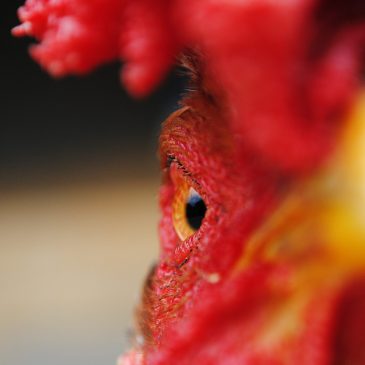
As we began to conceptualize our blog, we knew a fundamental element would be the picture we chose to represent us. Imagery has a way of conveying meaning more quickly and comprehensively than a narrative. An image invites the observer to enter a story which begins with the perspective of the architect but is ultimately augmented by the interpretation viewer. There is an unassailable truth in the adage “a picture is worth a thousand words.” But what does a picture of a rooster communicate? Thus, began our search for the perfect representation.

Do you know how many rooster pictures are available on the internet? Thousands. I looked at more rooster pictures than I thought possible: cartoon roosters, graffiti roosters, drawings of roosters, rooster sculptures, rooster tattoos, toy roosters, real roosters, roosters on farms, roosters in the wild. If you can draw it, painting it, sculpt it, photograph it, or conceptualize it – it’s out there. After mind-numbing hours of scrolling through rooster images, I came across a photo by Jairo Alzate on Unsplash.com. I’ll admit my initial glance left me wondering if the out-of-focus picture was purposeful or a result of tired-head. It was that slight double-take however, the need to lean into my screen with a furrowed brow and ask the question “Is that seriously a rooster?” that affirmed we’d found our representation!  I think we can safely say Jairo Alzate is a genius! Who else would think to take an ultra-close-up of a rooster? I wondered for about half a second if the photo wasn’t too “in your face” and dismissed it entirely because the fact that it was “in your face” is what made it sublime!

The Wounded Rooster blog is about recognizing our wounds and in particular, how those wounds have shaped us and created stumbling blocks to loving God, ourselves, and others well. We love, but with a mere shadow of the unabandoned fervor for which we were intended. Woven into our belief systems, our wounds reverberate throughout the melody of our lives. They are expressed subtly and audaciously within the undertones of our relationship patterns and choices. They play out in every interaction; in that which we offer and that which we withhold.  They are in many ways, “in our face”, but they become so indistinctly characteristic of who we are that we tend to lose sight of them. While they remain in our field of vision, they are hazy, vague, and out of focus.

In the upcoming blog posts, we will share our perspectives, our knowledge and experiences, our mess and our failures, and the Truth we’ve discovered along the way. We invite you to lean in with us; to pause for a closer look, to focus your lens and ask the hard questions. In doing so, your own “roosters” will begin to emerge into view. With those sightings comes the freedom to choose your patterns of relating, and with choice, comes unceasing opportunities to experience and offer an indescribable love.

Photo by Jairo Alzate on Unsplash